Biol 337: Biology of Invertebrates
College of Charleston
Spring 2017
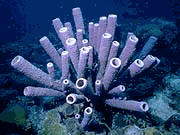
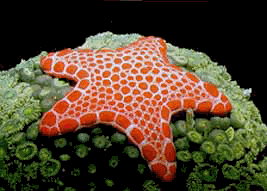
"No one with an unbiased mind can study any living creature, however humble, without being
struck with enthusiasm at its marvelous structure and properties" -- Charles Darwin
COURSE OVERVIEW and LEARNING OUTCOMES
How many different ways can you build an animal? Although all animals face the same basic challenges—how to consume, digest, move (or stay put), sense, defend themselves, exchange gases, eliminate wastes, reproduce, and so on—evolution has produced more than 30 distinct body designs that represent different solutions to these challenges. The so-called “invertebrates” (distributed among all animal phyla) include a far greater range of diversity in design than the "vertebrates" (just part of one phylum). My goal is to develop your ability to use the major phyla (and some lower taxa) as examples to illustrate these diverse solutions. Our comparison of body designs will reveal the radically different ways that animals have evolved over the last 600 million years to solve the same problems using different structures and processes.
As a hard-working and engaged participant in this course, you will come to be able to:
describe how different body designs solve (or create!) biological problems related to physiological and environmental challenges
contrast major animal groups with regard to how the body works in movement, growth, nutrition, respiration, water balance, excretion, defense, & reproduction
demonstrate how and why “shared, derived traits” are used to deduce evolutionary relationships
identify the major characters that are used to deduce relationships among the major animal taxa
describe large-scale patterns in the history of animal diversity and identify general mechanisms that have led to variation in animal body design
explain why most animals should really be thought of as a series of radically different life cycle stages that experience different environments and selection pressures during their ontogeny
describe animals in the context of communities, ecological interactions, and conservation problems
- explain and use terms and taxonomic names that reflect your understanding of major concepts in animal form, function, and phylogeny
Along with introducing you to the diversity and evolution of animal body plans, my goal is also to develop your critical thinking skills through interactive lectures, readings from texts and primary literature, short writing assignments, laboratory exercises, and concept-centered exams. Your goal should be to pose questions, to seek evidence for answers, to look for patterns, and to organize information into a framework for talking about animal structure and function—that is, to practice thinking like a biologist. I also hope you will teach and learn from one another, especially when studying course material and completing laboratory exercises.
Syllabus information
- Exam information
- Lecture schedule
- Laboratory schedule
- How to complete writing assignments
- Laboratory safety policies
Downloadable files (username: biol337, pwd needed)
- Lecture guides and illustrations (must be printed for lecture)
- Lecture complete slides (study aid)
Supplementary readings (part of reading assignments)
- Phylogenetic trees (study aid)
Invertebrate concept map (for extra credit)
Score distributions on assignments/exams (Spring '15) (Spring '14) (Spring '13) (Spring '12) (Spring '11) (Spring '10) (Spring '09) (Spring '08) (Spring '07) (Fall '06) (Spring '06) (Fall '05)
Class photos (Spring '15) (Spring '12) (Spring '11) (Spring '07) (Spring '06)
CofC Biology homeGrice Marine Laboratory home
Please contact me (podolskyr'at'cofc.edu) with comments or corrections and before using any material.